Get started

How to create your Social Media Editorial Calendar

Whether it's for YouTube, Facebook, Instagram, LinkedIn or TikTok: Successful social media marketing requires foresighted and good content planning. This is exactly where the social media editorial plan comes into play. Here we explain what it is, what information a content plan should contain and why it is so important!

What is an editorial plan? Does every marketing team need an editorial plan? The basics of your editorial plan What does an editorial plan entail? Your very own editorial plan template Some helpful tools for your editorial plan A step-by-step guide for your next editorial plan 5 Tips for your editorial plan Conclusion

What is a social media editorial plan?

Most people think of newspapers and magazines when they hear the term ‘editorial plan’. However, it is also an important tool for strategic & above all successful content planning and creation in online marketing.

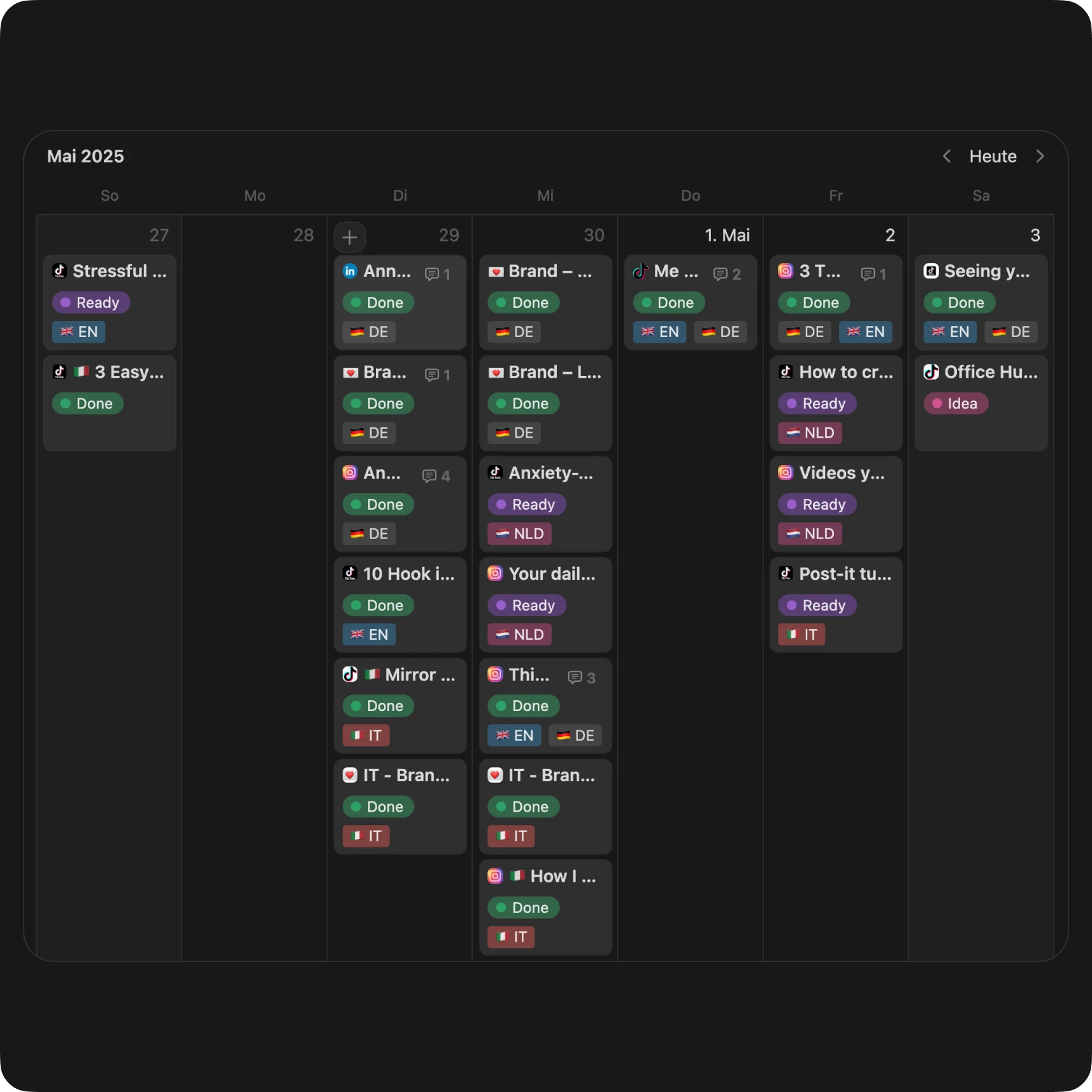
This is because an editorial plan clarifies which content is published at what time via which channels. With a well-structured social media editorial plan, you can maintain an overview and are optimally positioned in terms of content management.

Does every social media marketing team need an editorial plan?

Content planning is part of the daily work of every social media manager. Those who rely on an editorial plan can simplify many work steps and optimise results:

More control & overview
With a social media content plan, you not only see what is due today and tomorrow, but also have an overview of completed to-dos and long-term planned topics. It's obvious that this makes it easier for you to recognise whether goals and deadlines can be achieved. If things don't work out, you can reschedule at an early stage.

✅ Clear division of labour & assignment of tasks
An editorial plan is worth its weight in gold, especially when several people are working on social media content: work steps can be delegated more easily, responsibilities are immediately recognisable, everyone knows what they have to do and what the other person is currently working on. This means no one has to wait for additional work or ask for help by email.

Save resources through better time and budget planning
Forward-looking planning and an editorial plan allow you to estimate both the time and budget required for social media content more realistically.

For example, you can avoid content not being ready on time. This saves time and money.

Idea back-up for emergencies
And suddenly they're there - creative flashes of inspiration. Instead of scribbling spontaneous topic ideas on a piece of paper, they find a safe place in the social media editorial plan and can be found quickly. If you can't think of anything new for a social media post, this idea back-up can be a lifesaver and provide inspiration.

Strategic content funnel
Good planning and strategic sequencing of posts can generate a kind of funnel to guide users to the desired destination. For example, e-commerce brands can tease a new product range step by step, arouse potential customers' curiosity with ‘warm-up posts’ and ultimately guide them to the online shop.

In short, an editorial plan simplifies social media content management immensely and helps to improve the performance of each individual post.

The basics of your editorial plan

Social media content is not created in a vacuum, but is based on your overarching marketing and communication strategy. This strategy clarifies fundamental aspects that are also important for your social media content plan:

➡️ Target group and persona: Who are your (potential) customers and who do you want to reach with your social media posts? Define your target group as precisely as possible.

➡️ KPIs: Define key performance indicators (KPIs) that you can use to measure the short and long-term success of your social media marketing. The choice of KPIs depends on the type of content, the channels and your goals, among other things.

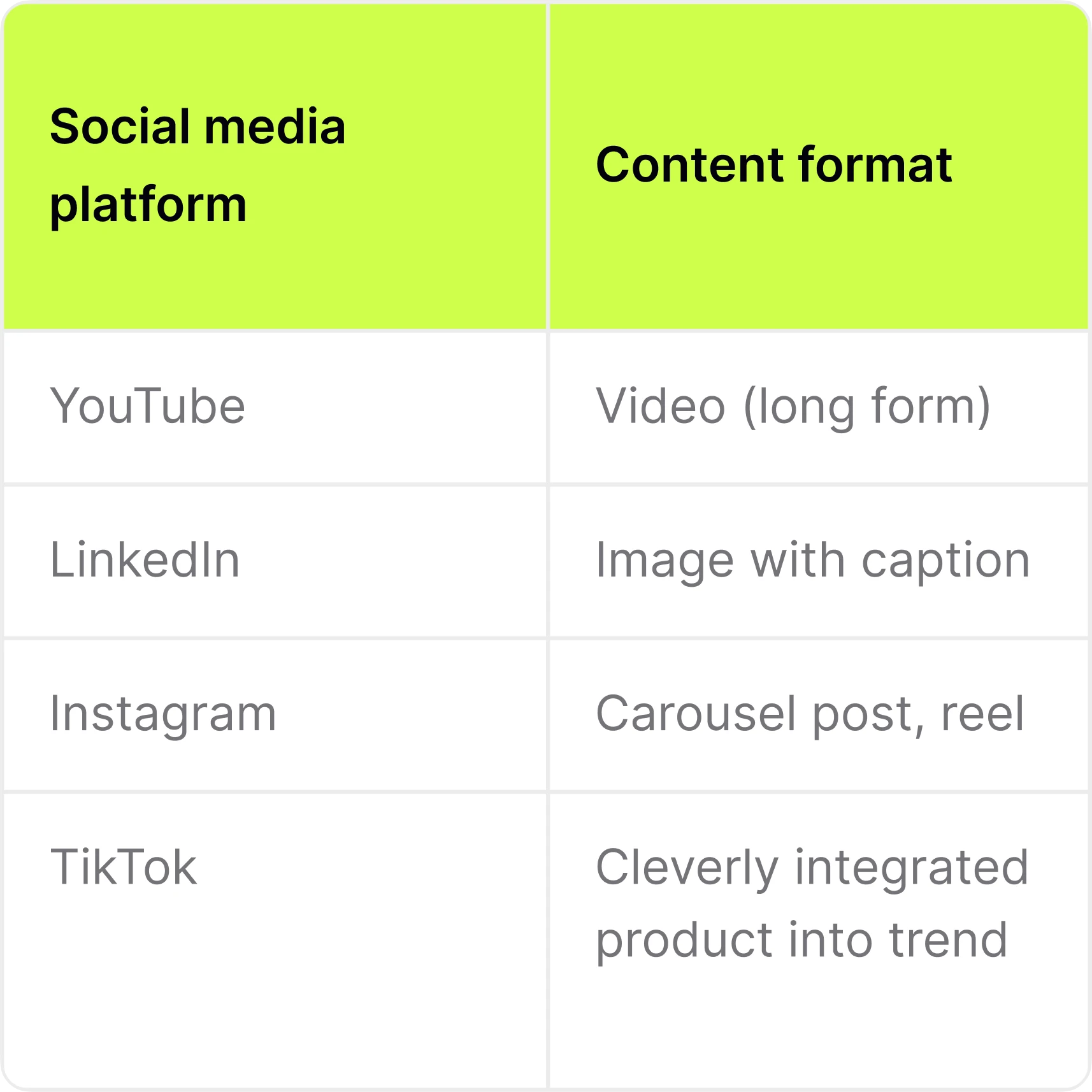
➡️ Platforms and formats: Which social media channels is your target group active on? Depending on the platform, you should plan different content formats: TikTok and YouTube are of course impossible without videos.

You can land on Instagram and Facebook with images, memes and graphics. Texts and statistics are in demand on LinkedIn, for example.

➡️ Objective: What are the overarching goals you are pursuing with your social media presence? Possible objectives are

  • Higher traffic to your website

  • Increase brand awareness

  • Improve brand image

  • Increase sales figures

  • Strengthen customer loyalty

  • Win new customers

💡 By the way:

Social networks are predestined to receive targeted user content that you can use for your advertising purposes and campaigns. User-generated content (UGC) in the form of positive ratings, comments or even specially produced review videos from satisfied customers is particularly authentic, fits natively into users' feeds and is not immediately perceived as a marketing measure.

What type on content is part of an editorial plan?

First things first: there is no such thing as the ‘one ultimate and only correct editorial plan’. However, some information is indispensable in every content plan:

  • What do you want to communicate (What is the topic or core message?)

  • How do you want to communicate content? (video, image, text, graphic, meme, gif, etc.)

  • Where should the content be published?

  • When should posts be published?

  • Who is responsible for the content?

Your editorial plan template

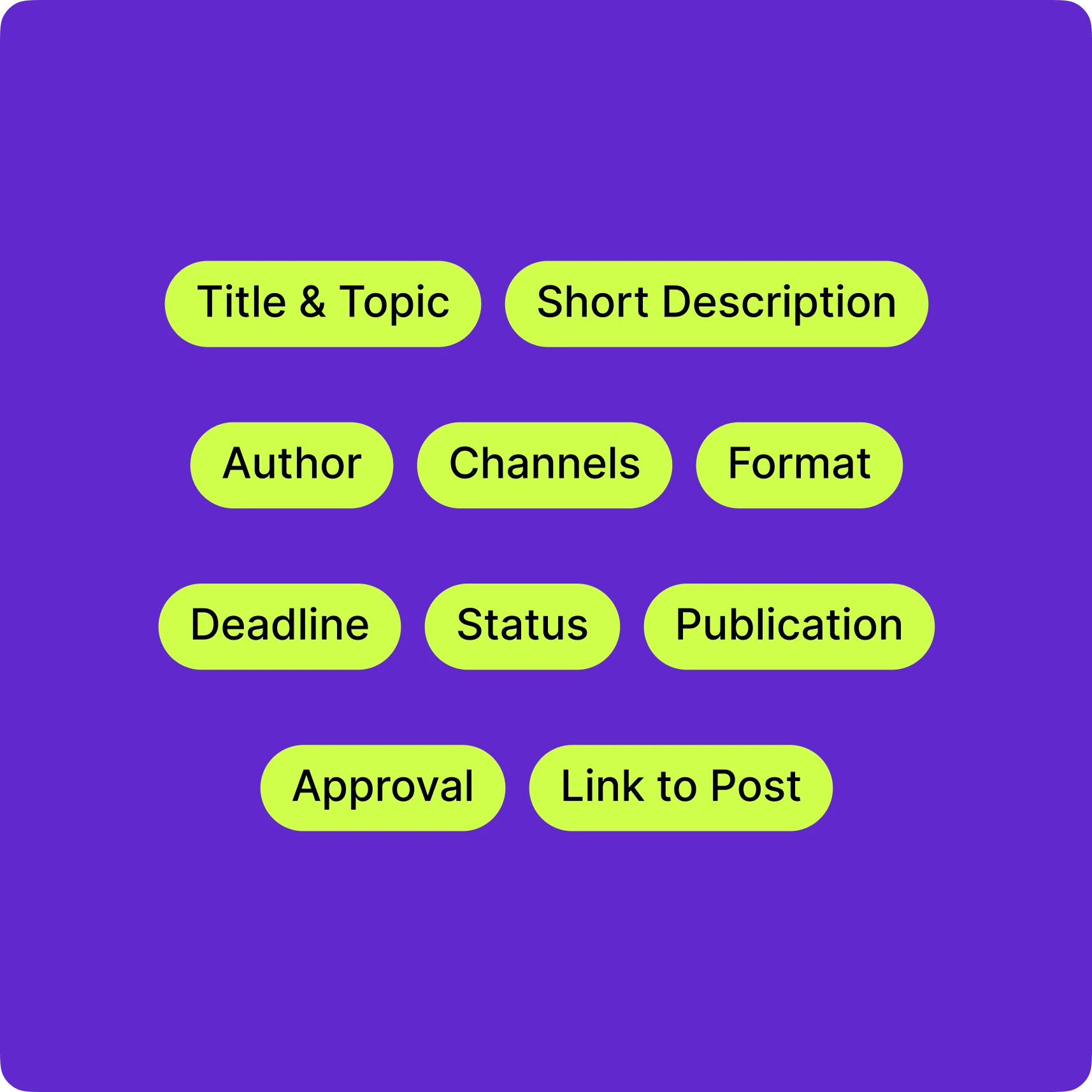
To save you work, we have created a template for your social media content plan:

  • Title & topic of the post (incl. topic category if applicable)

  • Short description (summary of the content)

  • Author or person responsible for the creation

  • Channels of publication (e.g. Instagram, TikTok, etc.)

  • Format (e.g. video, text, image, graphic, meme, etc.)

  • Status (e.g. in progress, feedback, ready, etc.)

  • Deadline for the completion of the content

  • Approval by XY (usually customer)

  • Planned publication

  • Link to the post after publication

It is important that you adapt the content and precise structuring to your product or service area and your individual work steps. To highlight responsibilities, priorities and urgencies, you can also use individual colours or emojis in your social media editorial plan.

Some helpful tools for your editorial plan

There is also no general right or wrong answer to the question of how to set up and use an editorial plan. For small brands with manageable social media content, a spreadsheet in Microsoft Excel or Google Drive is often sufficient. The document can be shared with all employees via the cloud and edited together.

Specialised editorial planning tools are more professional. These offer some extra functions, but are usually subject to a fee. For example, the programmes send email reminders of open to-dos or approaching deadlines and simplify planning with a calendar mode. Specialised social marketing cloud software, such as Emplifi (formerly Social Marketing Cloud), is particularly recommended for teams that coordinate a large number of communication and marketing measures on different channels:

Classic project planning tools are a popular alternative. A calendar view is usually integrated here too. You can assign tasks (or posts) to responsible colleagues and set deadlines and email notifications for upcoming to-dos. Possible project planning tools for your social media content planning are:

The most important thing when selecting software is, of course, that everyone involved can work well with the tool.

Building your editorial plan step-by-step

All beginnings are difficult? Our step-by-step guide to your social media content plan will help you get started and stay on track in the long term.

1. Create a topic plan
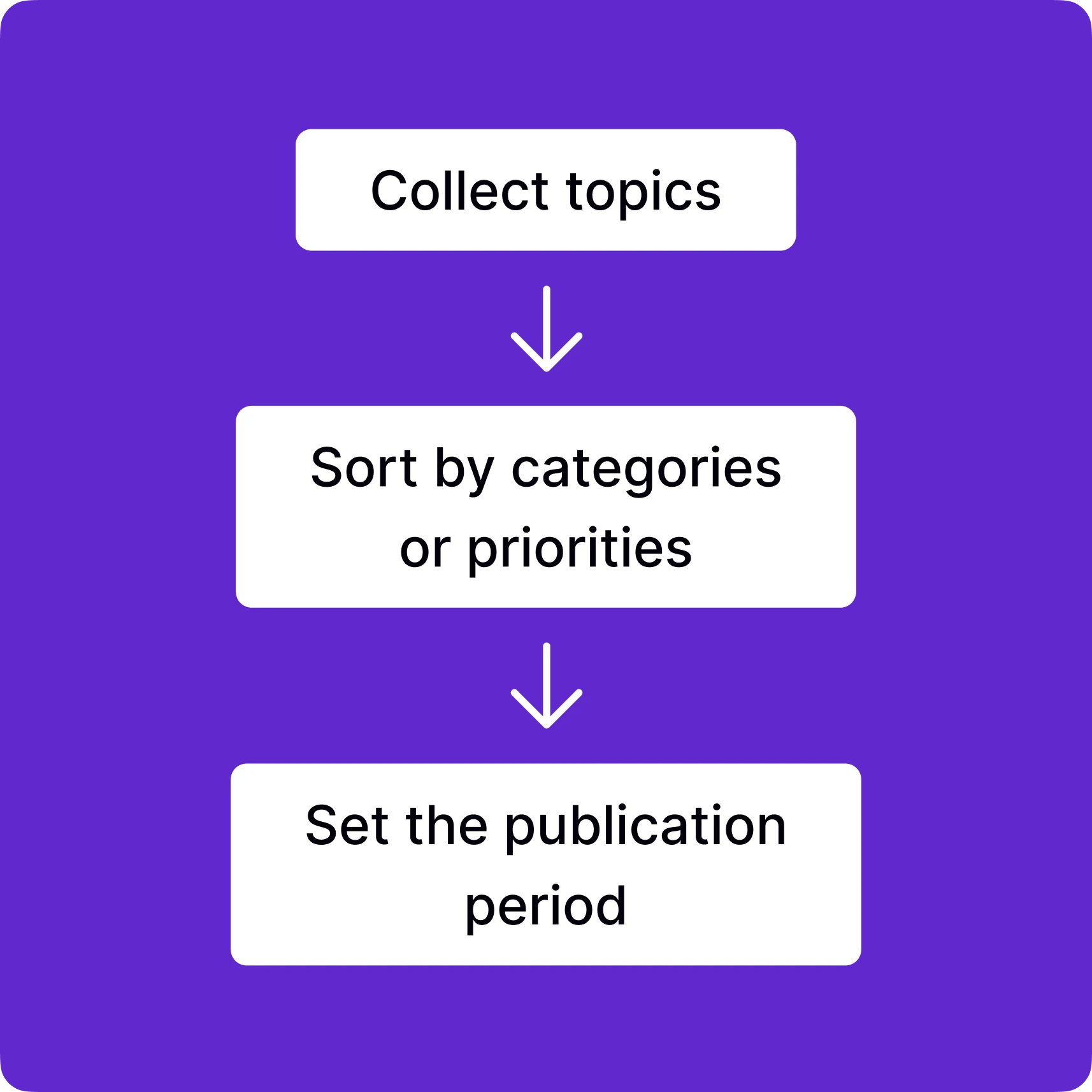
A topic plan serves as a basic framework and initial template for your editorial plan. You can collect and sort loose content ideas here. Write down all topics that fit your brand's product or service area and could be relevant for your target group. It is best to organise the topics according to categories or priorities. You can also record the rough time frame for publication. This is particularly useful for topics that are relevant to certain seasons, holidays or recurring events such as Halloween.

2. Define your channels and formats

Not every topic and not every format is suitable for every social media channel. LinkedIn users, for example, are more likely to look at longer texts and graphics than Facebook users, whose attention you are more likely to attract with an appealing image or snappy slogan. The younger target group is mainly on TikTok, YouTube and Instagram. Here you need videos that have to be prepared differently depending on the channel. In the editorial plan, you record for each topic on which social media channels and in which form the respective content should be distributed.

3. Find the best upload slots

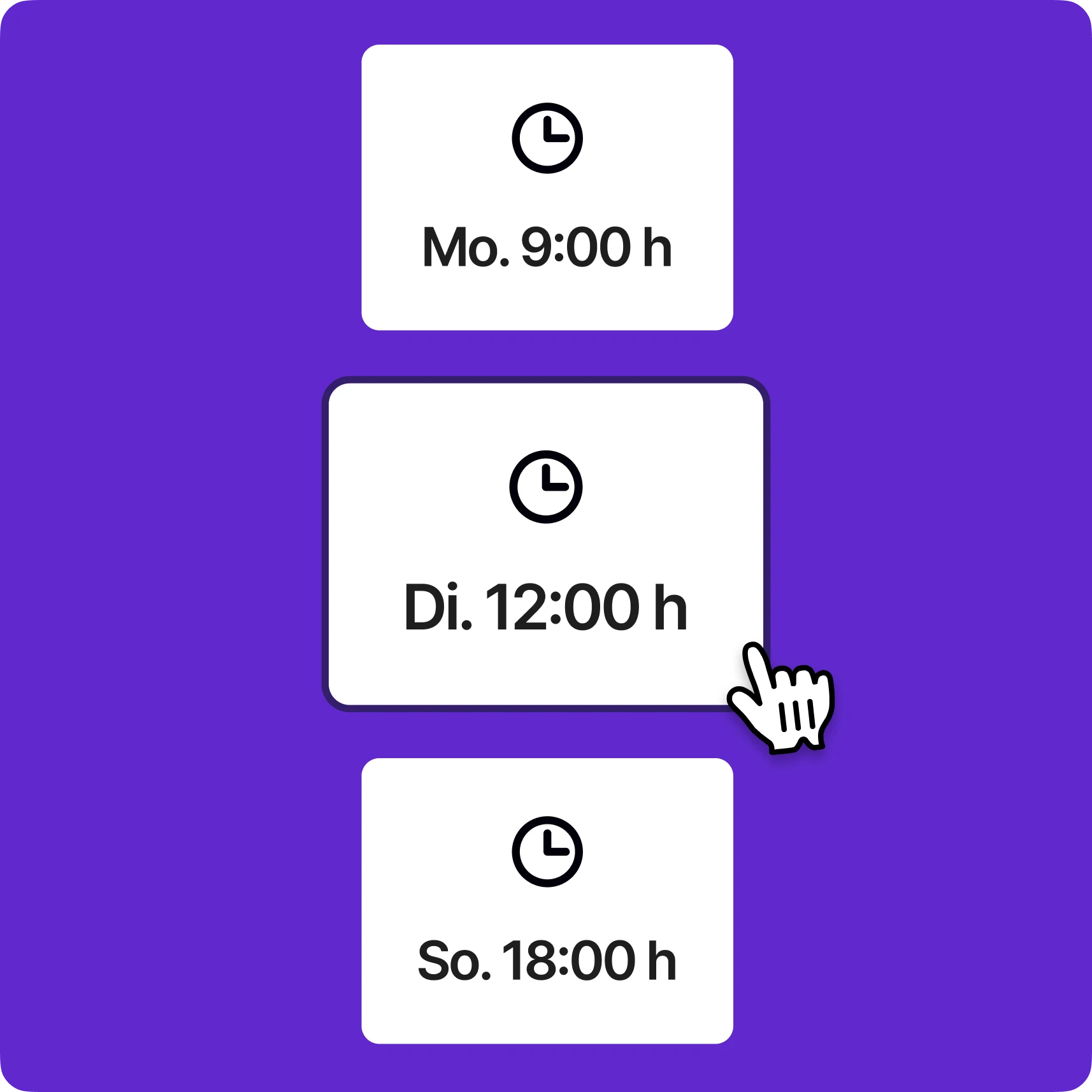
The right time to publish your posts is particularly important for successful social media marketing. This is because users are online at very different times and are not "receptive" to every type of content around the clock. Tools such as Later, Fanpage Karma and Facebook Insights help you to find out when your target group is online. Not only can you determine the optimal time, but you can also adjust the frequency of posts to their habits.

4. maintain your posting rhythm

The regularity of your posts is at least as important as the timing. Ideally, you should not only post continuously, for example three times a week, but also always on the same day of the week and at the same time. With professional social media software, you can even set posts to go live automatically. However, some social media platforms do not like it when external tools take over the posting. As an alternative for automated publishing, we recommend using the platform's own tools such as Facebook's Content Creator.

5. Monitor your success
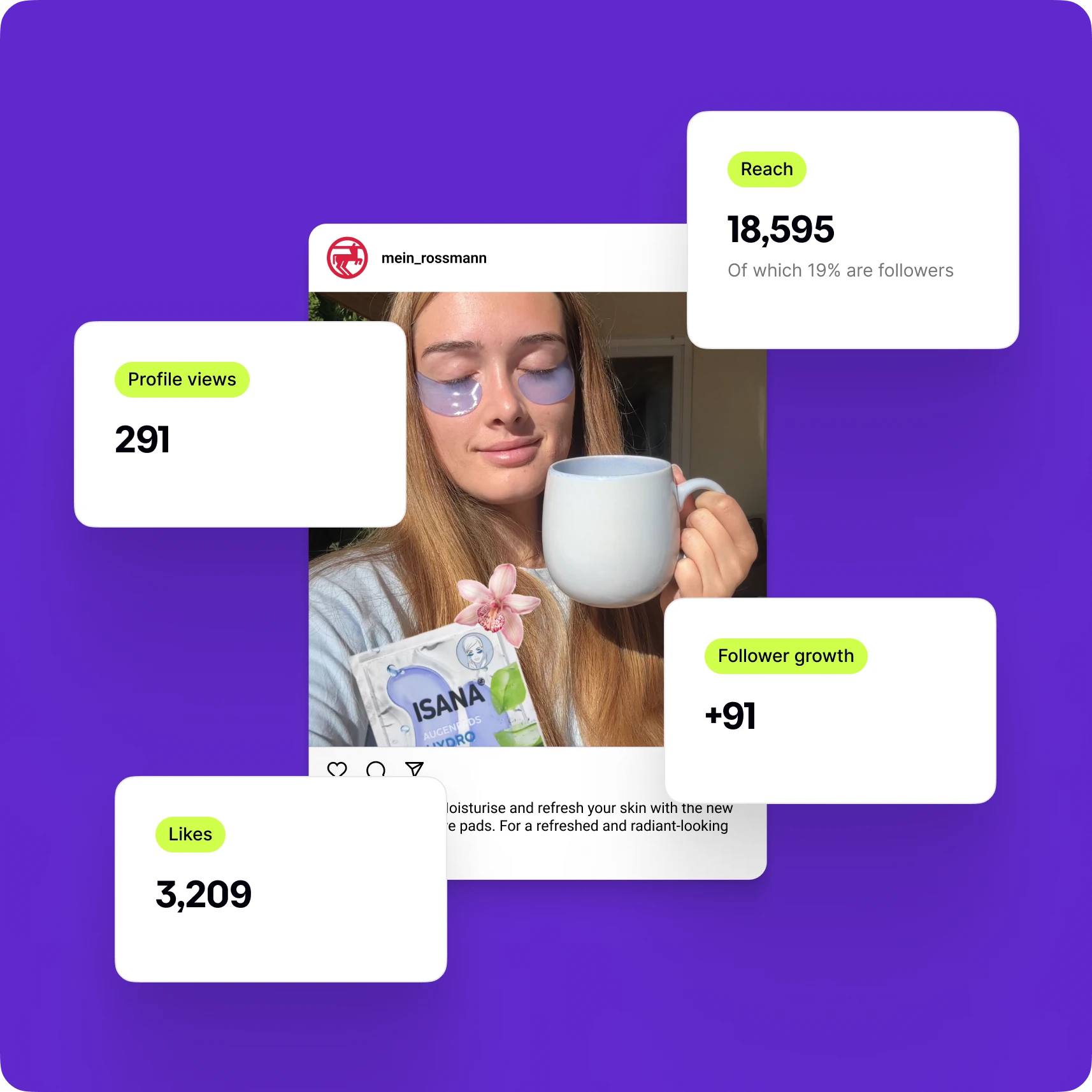
As with any marketing measure, the motto for social media content is "measure, analyse, adapt". Interactions such as likes, shares and comments can already provide information on whether a post is well received. However, you should also keep an eye on other defined KPIs. They tell you whether your content plan for social media actually corresponds to your overarching marketing goals. If not, you should look into the possible reasons for this and reschedule accordingly.

5 tips for your editorial plan

✅ Keep your editorial plan up-to-date
Regularity and topicality are the be-all and end-all of social media marketing. This not only applies to your posts, but also to your social media editorial plan. The plan must always be up to date so that everyone involved knows what they have to do at all times. Check the details and, above all, the processing status of the to-dos regularly.

✅ Only good content is king
Much more important than the number of your posts is that they are relevant to your target group, arouse interest and, ideally, are shared, liked or commented on. In other words: prioritise quality over quantity when planning your content and make sure that your content has real added value.

✅ Offer a variety of content
Ideally, your social media channels should alternate between informative content and entertaining, informal posts. Of course, a common thread should be recognisable both visually and thematically. The format and style of the content must also match your brand, the respective channel and the overarching communication strategy. Basically, however, it's the mix in your editorial plan that makes the difference.

✅ Motivate your community to interact
Lots of comments, likes and shares have a positive effect on the visibility of your posts. Therefore, include a call-to-action (CTA) or open question in your content, for example at the end of a video or in the image description. This allows you to integrate your community even more specifically into your content strategy: Use their comments or even posts that mention your brand or product for your social media marketing! We have summarised how you can use this user-generated content and how you can get hold of such content in our big UGC guide.

✅ Pro tip: Use a seeding plan
Because social media channels differ in their possibilities and often also in their purpose, they need to be ‘fed’ with different content. This is where the seeding plan comes into play. This is always a good idea if you are researching and creating content for newsletters, blog posts or press releases, for example. You can also play out this content in small ‘bites’ on your social media channels. The seeding plan defines which content or aspects of the finished content should be included in the individual social media posts.

Conclusion: Being well prepared is half the battle

Squeezing an interesting post out of your fingers at the last minute? With an editorial plan, you can save yourself this stress and continuously optimise your social media content. Good preparation leaves more time and nerves for research, brainstorming and the successful realisation of content. In other words, if you want to be successful with social media content in the long term, there's no getting round an editorial plan.

If you want to include compelling videos for your social media channels in your online marketing strategy, Speekly is the right place for you! We bring you together with creative creators who produce customised, authentic UGC videos for you.